
2 December, 2025
We are deeply honoured to welcome Professor John Day, Emeritus Professor of Hebrew Bible at the University of Oxford, UK, to lead a session of the Sacred Literature in Interfaith Contexts Reading Group.
Or Scan the QR Code below


(Illustration to the Book of Job by William Blake)
Topic: The Book of Job and Innocent Suffering
Abstract: The book of Job grapples with the problem of innocent suffering to an extent otherwise unparalleled elsewhere in the Bible. Job and his three friends, the so-called ‘comforters’ Eliphaz, Bildad and Zophar, spend much of the book debating whether Job’s terrible suffering (resulting from the loss of his possessions and children and the infliction of a painful skin disease) is the result of his being a notorious sinner or not (Job 3-31).
Overall, what is the book trying to say? Here, I shall support a multi-faceted approach. I shall argue that
(1) the book asserts that innocent suffering is a reality, contrary to what some other parts of the Hebrew Bible might suggest.
(2) The Prologue (chs. 1-2) implies that suffering can serve as a test of the disinterestedness of one’s piety. Do we truly love God for himself or only for what we can get out of him?
(3) The first divine speech (chs. 38-39) implies that, unlike God, the puny human mind cannot fully understand the mysteries of the universe, so how much less can it fathom human suffering. In the second divine speech (Job 40.6-41.34 [Heb. 26]), God asks Job if he can overcome the monsters Behemoth and Leviathan (which are not the hippopotamus and crocodile, as many suppose). Since the answer is no, the implication is how much less can one overcome God in argument.
(4) The Epilogue (ch. 42.7-17), when Job’s happy life is restored, implies that in the end God puts everything right. However, this is not yet in a blessed afterlife, a belief that developed later in Jewish Apocalyptic, and seemingly already in the Wisdom Psalms 49 and 73. Job 19.25-27 is not about seeing God in the afterlife but in this world, contrary to Handel’s ‘Messiah’ and many others!
(5) Finally, Job does find God in his suffering, even if it’s only at the very end of the suffering (Job 42.5).
I shall also consider the question whether the book of Job is a unity, maintaining that the speeches of Elihu (chs. 32-37) and the speech about Wisdom (ch. 28) are later additions, but otherwise the book is a unity; I defend the authenticity of the second divine speech (chs. 40.6-41.34 [Heb. 26]), unlike some scholars. I shall also discuss whether the book of Job is rightly considered a part of the Bible’s ‘Wisdom literature’, and how it relates to other parts of the Hebrew Bible and other ancient Near Eastern literature.
Interestingly, the person Job is not represented as an Israelite but an Edomite (an inhabitant of southern Transjordan; Job’s so-called three ‘comforters’ and Elihu are also non-Israelites). I shall discuss how an Edomite could be the hero of a Jewish book when Edomites were especially hated in the post-exilic period (cf. Lamentations 4.21; Psalm 137.7; Obadiah; Malachi 1.2-4), the time when the book was written.
Speaker: Professor John Day, Emeritus Professor of Hebrew Bible, University of Oxford, UK
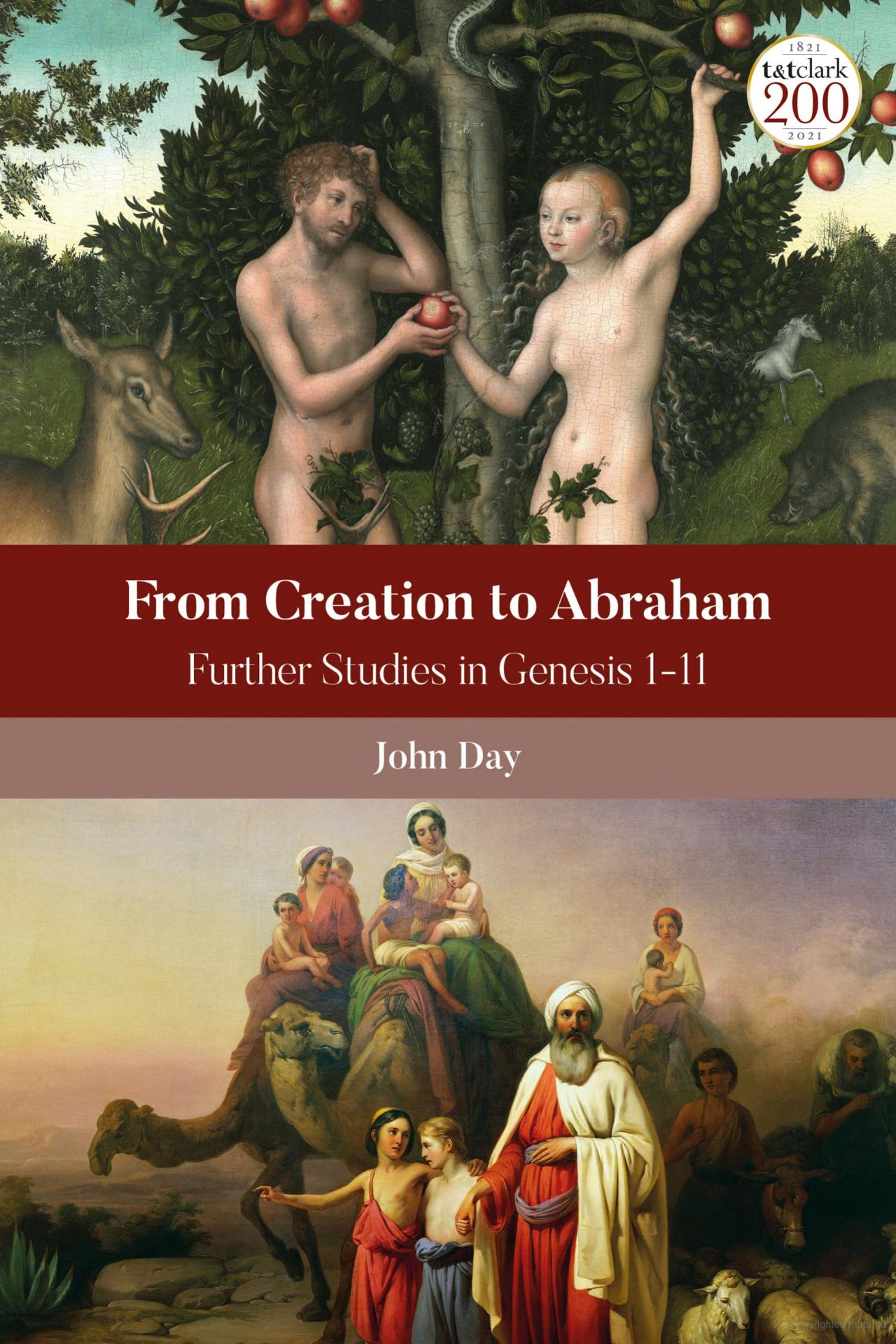
Speaker’s biography: Professor John Day has been Fellow & Tutor of Lady Margaret Hall in Old Testament Studies since 1980, now Emeritus. Prior to coming to Oxford, he studied at Christ’s College, Cambridge, and held Fellowships at the Hebrew University of Jerusalem and Durham University. He holds both a Cambridge PhD and an Oxford DD. In 2014 he was President of the Society for Old Testament Study. Prof Day has published widely on the Old Testament/Hebrew Bible, including 17 books, over 75 articles and 200 book reviews. His early work mainly centred on the impact of Canaanite religion and mythology on the Hebrew Bible, including books on ‘God’s Conflict with the Dragon and the Sea’, ‘Molech’, and ‘Yahweh and the Gods and Goddesses of Canaan’, and an article on Asherah which was awarded a prize by the Society of Biblical Literature. He co-edited the Festschrift for J.A. Emerton on ‘Wisdom in Ancient Israel’ and discovered and published William Robertson Smith’s previously lost 2nd and 3rd series of ‘Lectures on the Religion of the Semites’. His middle years were much taken up with editing, including four Oxford seminar volumes on ‘King and Messiah’, ‘In Search of Pre-Exilic Israel’, ‘Temple and Worship’, and ‘Prophecy and the Prophets’, and he spent 3 years editing the SOTS Book List. More recently, his work has centred on Genesis 1-11, on which he has written two volumes of essays, ‘From Creation to Babel: Studies in Genesis 1-11’ and ‘From Creation to Abraham: Further Studies in Genesis 1-11’. Prof Day is now working on the commentary on Genesis 1-11 in the prestigious International Critical Commentary (ICC) series.
Chair: Prof Jacob Wright, Fellow of the Oxford Interfaith Forum
Time: 18:00-19:00 GMT | 19:00-20:00 CEST | 10:00-11:00 PST | 13:00-14:00 EST
Venue: Online
Some of Professor John Day’s publications
Related Sessions
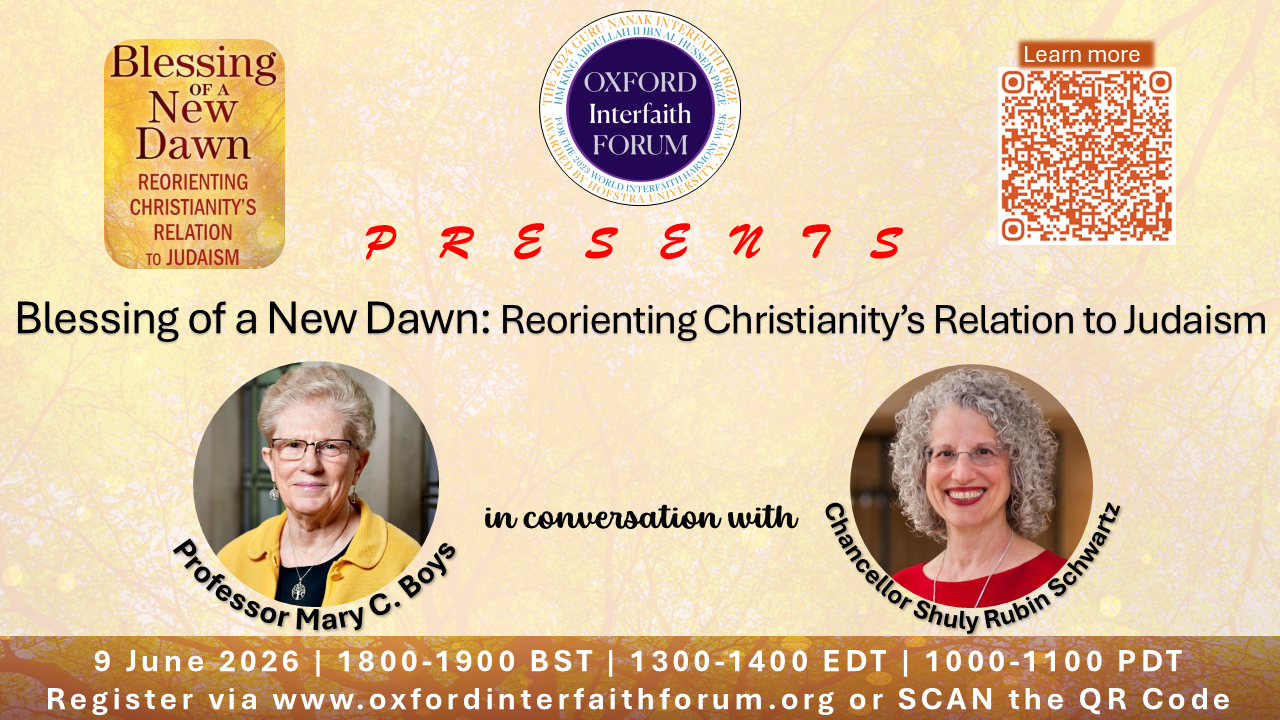
- Blessing of a New Dawn: Reorienting Christianity’s Relations to Judaism
- Scriptural Vitality: Rethinking Philology & Hermeneutics

- The Unbegotten Begotten Christ: How the Qur’an Agrees with the Gospel of John

- The Book of Job and Innocent Suffering
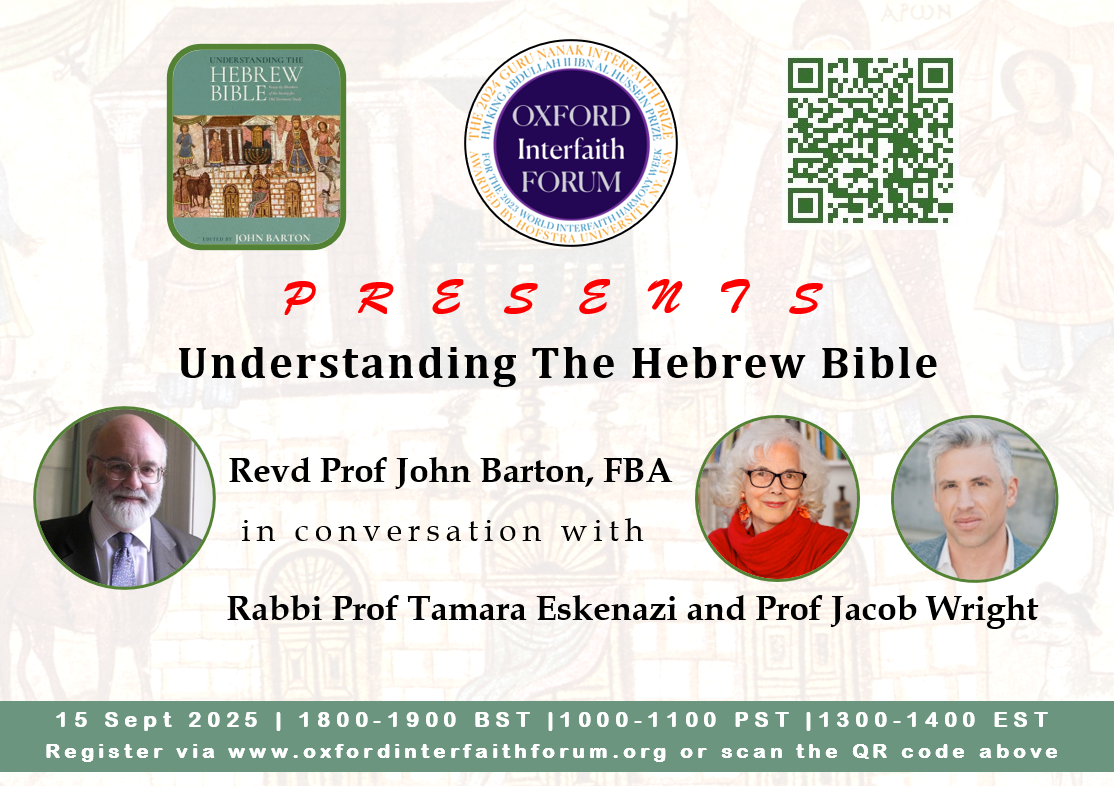
- Understanding The Hebrew Bible
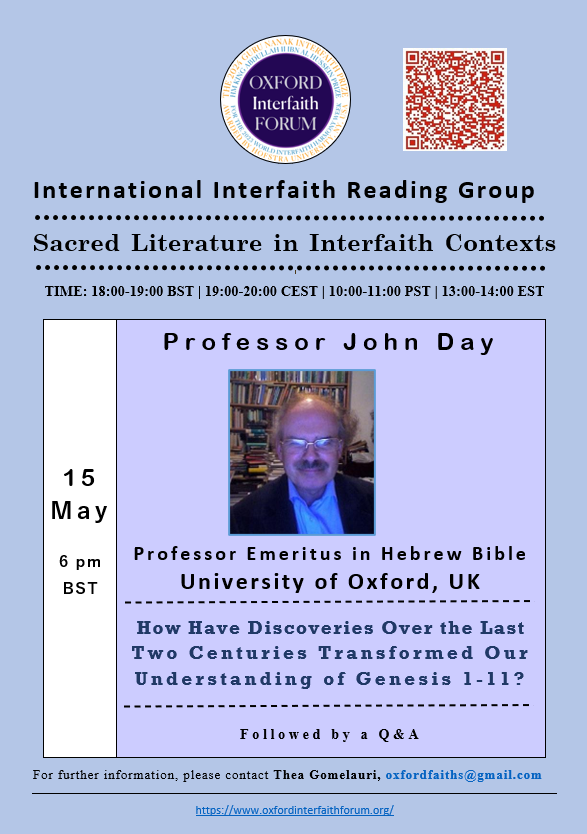
- How Have Discoveries Over the Last Two Centuries Transformed Our Understanding of Genesis 1-11?
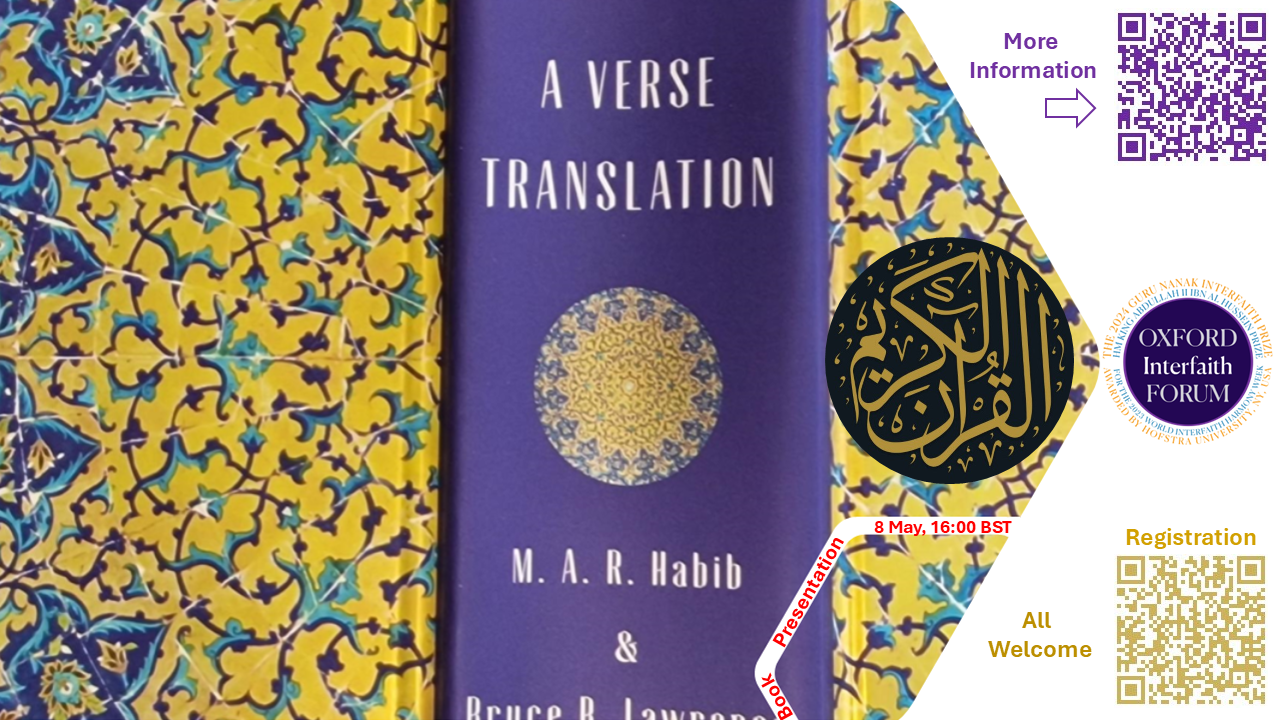
- Presentation of ‘The Qur’an: A Verse Translation’
- Why The Bible Began: An Alternative History of Scripture and Its Origins
- The Talmud among Victorian Christians: Polemics and Humanism in Interfaith Encounters
- Seventy Languages (and Translations) for Seventy Nations
- Where does One Encounter the Divine? Dialogue Between the Sexes in the Talmud
- From the People of the Book to the Books of the People: Christian Literature and the 19th Century Ottoman Turkish Literary World
- How Christians Can Learn from the Devotional Poetry of Hindu South India
- Literary Form and Meaning in the Hebrew Bible
- Reorienting Christian Understandings of Judaism: Insights from Biblical Scholarship
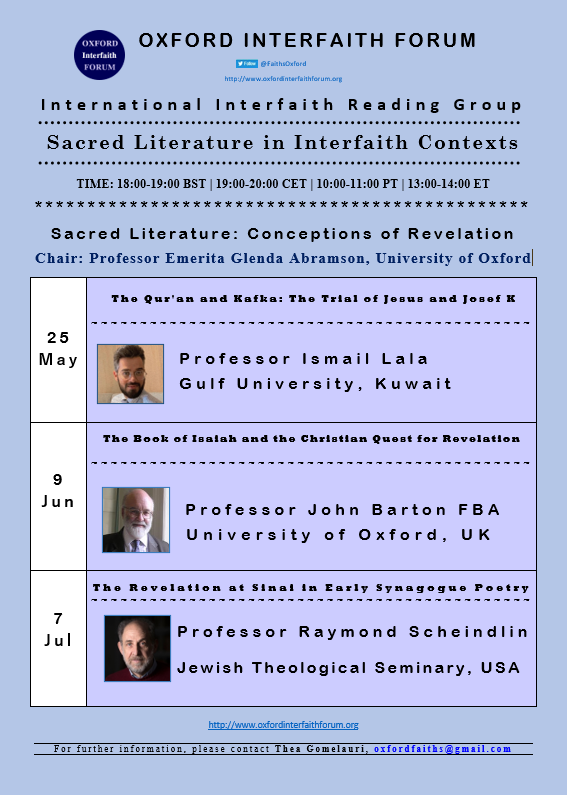
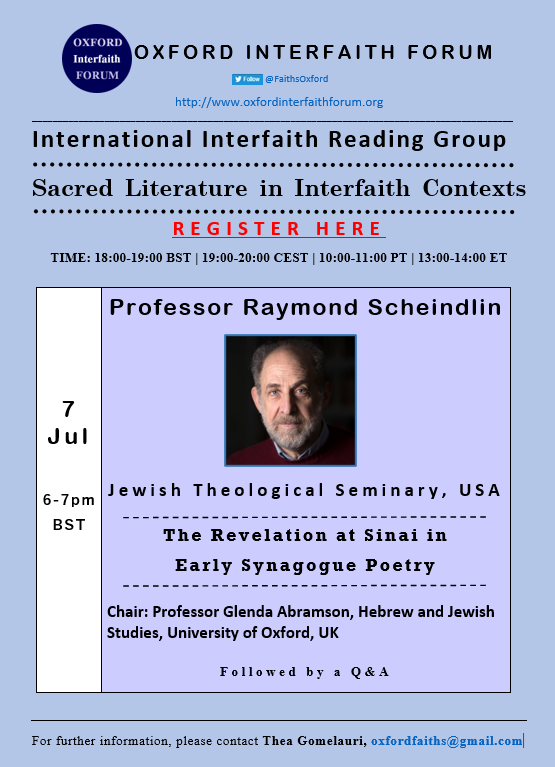
- The Revelation at Sinai in Early Synagogue Poetry
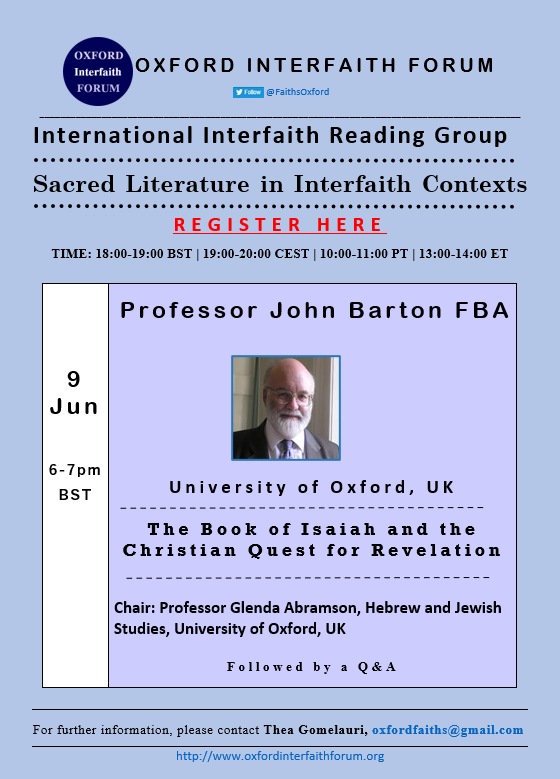
- The Book of Isaiah and the Christian Quest for Revelation
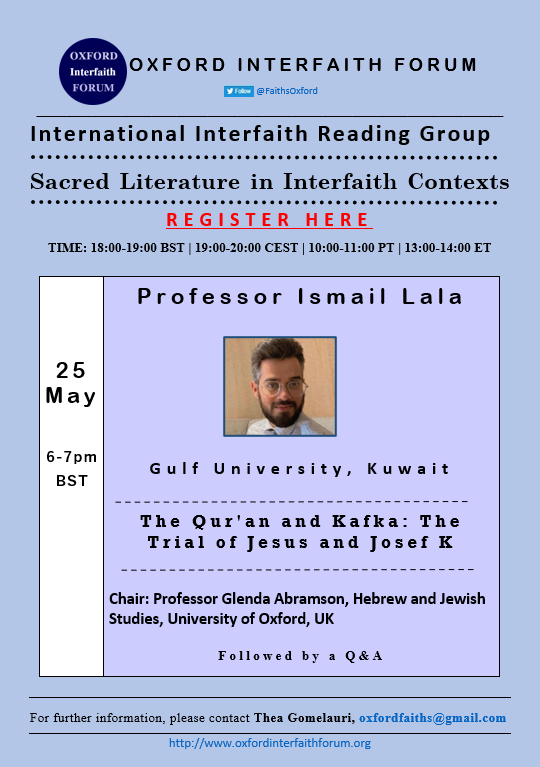
- The Qur’an and Kafka: The Trial of Jesus and Josef K
- Conceptions of Revelation in Interfaith Contexts