
26 January, 2026
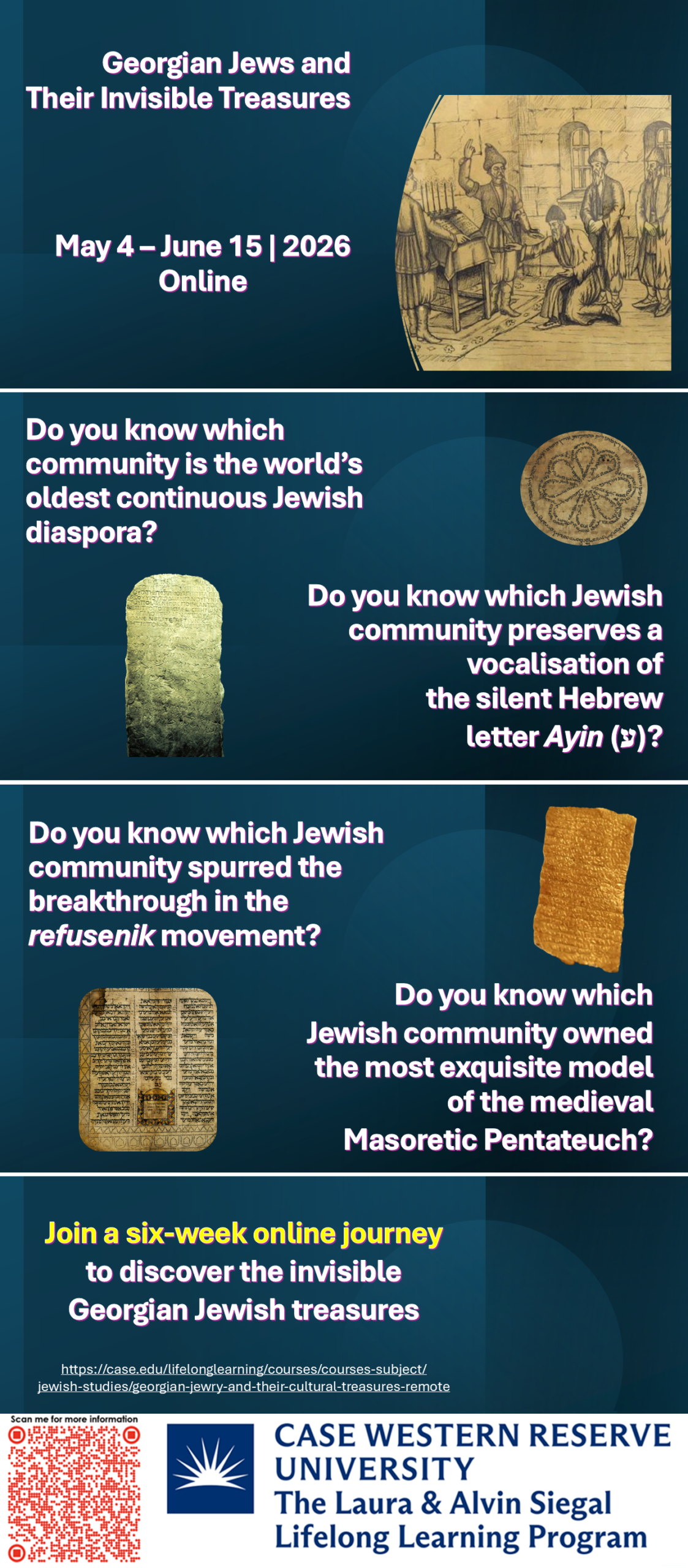
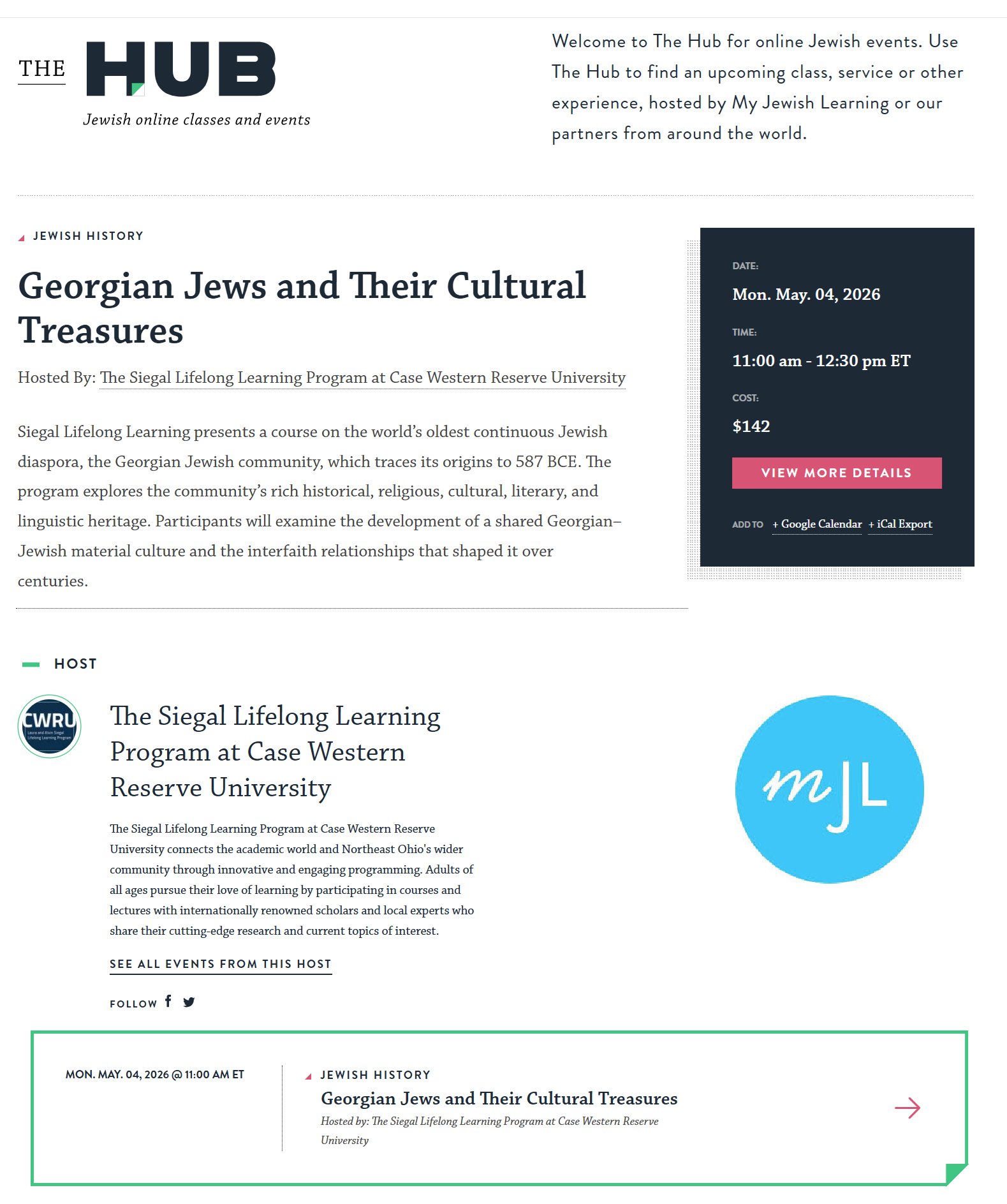
Siegal Lifelong Learning Programme at the Case Western Reserve University introduces the new online course, GEORGIAN JEWS AND THEIR CULTURAL TREASURES, designed and delivered by Dr Gomelauri.
The Georgian Jewish community boasts a rich and unique heritage spanning centuries, making it one of the most fascinating groups in Jewish history. Have you ever wondered which community is recognised as the world’s oldest continuous Jewish diaspora, or do you know which Jewish community preserves a vocalisation of the silent Hebrew letter Ayin (ע)?
Are you curious about the background of the breakthrough in the refusenik movement?
If you want to learn about these remarkable aspects of Jewish history, our six-week online journey will reveal the answers and much more about the Georgian Christians, Georgian Jews, and Georgian Muslims. The programme offers exclusive access to rare archival materials. Participants will explore historical milestones, linguistic traditions, cultural practices, and resilience unique to the Georgian multifaith landscape.
No prior knowledge required—everyone is welcome!
Discover Georgian Jewish Treasures in a six-week online course presented by
Case Western Reserve University Siegel Lifelong Learning


Georgian Jewry represent one of the most vibrant and significant expressions of Jewish life. Widely regarded as the longest continuous Jewish community in diaspora—dating back to the Babylonian exile according to historical records—this group has maintained its traditions for over two millennia. Nonetheless, little is known about this unique Jamaat (an Arabic word for ‘community’ used by Georgian Jews for self-identification), whose artefacts include distinctive religious practices, traditional music, Judeo-Georgian language, and unique linguistic expressions.
The six-week online course explores the history of the most colourful strand of the Jewish cultural landscape from the classical period to the present day. In addition to their rich history, Georgian Jews developed a unique material culture that reflected their close ties with local communities. The participants will learn about the exemplary interfaith relations that have shaped Georgian Christian, Georgian Jewish, and Georgian Muslim communities over the centuries, including miracle-working manuscripts, the Lailashi Codex (the unique Masoretic Pentateuch treasured by Georgian Jews) and the Bret Bibles. The course will introduce Qivruli (עברולי), the distinctive Judeo-Georgian language spoken by the community, also known as chveneburuli.

The home of Georgian Jews is a major crossroad where multiple cultural, ethnic, linguistic, and religious communities intersect. The exploration of how they interacted with and shaped their neighbours’ material culture draws on a range of academic fields: Jewish Heritage, History of Christianity, Religious Studies, Medieval Manuscripts, Linguistics, Interfaith Relations, and Early Modern Narratives. For example, Georgian Jewish artisans collaborated with Christian neighbours in manuscript illumination, blending iconographic motifs from both traditions. Linguistics reveals shifts in communal identity through language adoption, while medieval manuscripts provide evidence of shared religious rituals across communities. Additionally, the adoption of certain architectural features in synagogues and churches provides tangible evidence of mutual influence and exchange.
Dr Gomelauri approaches the topic through a diverse collection of visual and textual culture utilising Aramaic, Arabic, Georgian, Hebrew, and Russian texts, epigraphic artefacts, and excavated materials. Studying these sources sheds new light on highly significant but understudied episodes of Eurasian historiography and challenges some assumptions about medieval history. Specifically, this research questions the notion that Jewish communities were isolated from their neighbours, instead demonstrating their active participation in regional trade networks and shared religious practices. By providing concrete examples of cross-cultural collaboration and linguistic adaptation, Dr Gomelauri’s work reveals the complexity of communal identities and the interconnectedness of Eurasian societies during the medieval period.
Registration opens on 16 February 2026.
To cite: Gomelauri, Thea. 2026. “Case Western Reserve University Launches ‘Georgian Jews and Their Treasures’“. Oxford Interfaith Forum Website. Web address: https://oxfordinterfaithforum.org/blog/case-western-reserve-university-hosts-new-course-designed-by-dr-thea-gomelauri. Retrieved Month-Date-Year. Attribution: Creative Commons Share-Alike 4.0 International.
____________________________________________________________________________________________________________
Dedicated to the 40th Yahrzeit of Dr Nisan Babalikashvili (Z”L), the first Georgian Jewish scholar at the Oriental Institute of the National Academy of Georgia. He authored the pioneering research study on Jewish Epigraphs in Georgia, opening new avenues for understanding Jewish history in Georgia.